
Electronic plant protection records from 2027: what winegrowers need to know now
From 1 January 2027, professional users must keep their plant protection records electronically and machine-readably. The basis is EU Implementing Regulation 2023/564; the start was pushed back from 1 January 2026 to 2027 by Regulation (EU) 2025/2203. A PDF does not count as machine-readable. Permitted formats are CSV/Excel, XML, JSON — or a digital field record book.
Who is affected?
All professional users of plant protection products — so in practice every winery, regardless of size. The record-keeping obligation itself isn't new (it has been in Article 67 of Regulation (EC) 1107/2009 for years). What is new is the scope of the records and the form in which they must be kept.
What applies from when?
The EU adopts Implementing Regulation 2023/564. It sets new rules for how the records under Article 67 of Regulation (EC) 1107/2009 must be kept.
The extended mandatory fields apply: EPPO code, BBCH stage, georeferenced area, authorisation number, time of application.
The records must be kept electronically and machine-readably. This was originally planned for 2026 — Regulation (EU) 2025/2203 pushed the start back by a year. No further postponement has been announced.
Transition in Austria: for applications made in 2027, the records must be available electronically for the first time by this date at the latest.
The mandatory fields in detail
These details must be documented for every application of a plant protection product:
| Mandatory field | What is it? | Where does it come from? |
|---|---|---|
| EPPO code of the crop | International code for the crop. For grapevines: VITVI. | A fixed code — set once, always the same. |
| BBCH stage | Growth stage of the vine at the time of application (e.g. BBCH 65 = full flowering). | From the BBCH scale for the grapevine; recorded at the time of application. |
| Georeferenced area | The specific vineyard — not just a name, but with a location reference. | From your eAMA areas (INVEKOS-GIS) or a digital field record book. |
| Authorisation number of the product | The register number of the plant protection product. | From the Austrian plant protection product register (BAES). |
| Time of application | Date (and time) of application. | Documented at the time of application. |
| Quantity / rate | Quantity applied in relation to the treated area. | From the spray plan or the product calculation. |
What does “machine-readable” mean?
Machine-readable means: a computer can process the data automatically — field by field, without a person having to type it up or interpret it.
- CSV or Excel files
- XML, JSON
- A digital field record book with export
- Paper booklets and handwritten lists
- A scanned page or a photo
- A PDF file — even if it was created on a computer
What applies in Austria?
The EU regulation applies directly. But the transitional and inspection provisions are implemented in Austria at provincial level — Upper Austria, for example, has amended its soil protection act for this. Most important in practice: for applications made in 2027, the records must be available electronically for the first time by 31 January 2028.
The records are checked during official inspections. The exact inspection and penalty provisions are provincial law and still moving — this page is updated continuously (as at: July 2026). Your reliable point of contact is your Chamber of Agriculture.
Checklist: are you ready?
- Do you already keep your plant protection records digitally (not on paper, not as a PDF)?
- Does every area you treat have a georeference (vineyard with a location reference)?
- Do you know the EPPO codes of your crops, and do you record the BBCH stage for each application?
- Is the product's authorisation number recorded with every application?
- Can you export your records in a machine-readable format at the push of a button?
If you answer no to any of these questions, now is the right time to switch — before the season, not on the deadline.
How you solve it with Vinitor
Vinitor is a digital field record book: you create the spray plan, Vinitor calculates the product and the quantity, and everything is documented automatically as you work — with EPPO code, BBCH stage, georeferenced area and authorisation number. The export is machine-readable. You don't need to know anything about regulations for that.
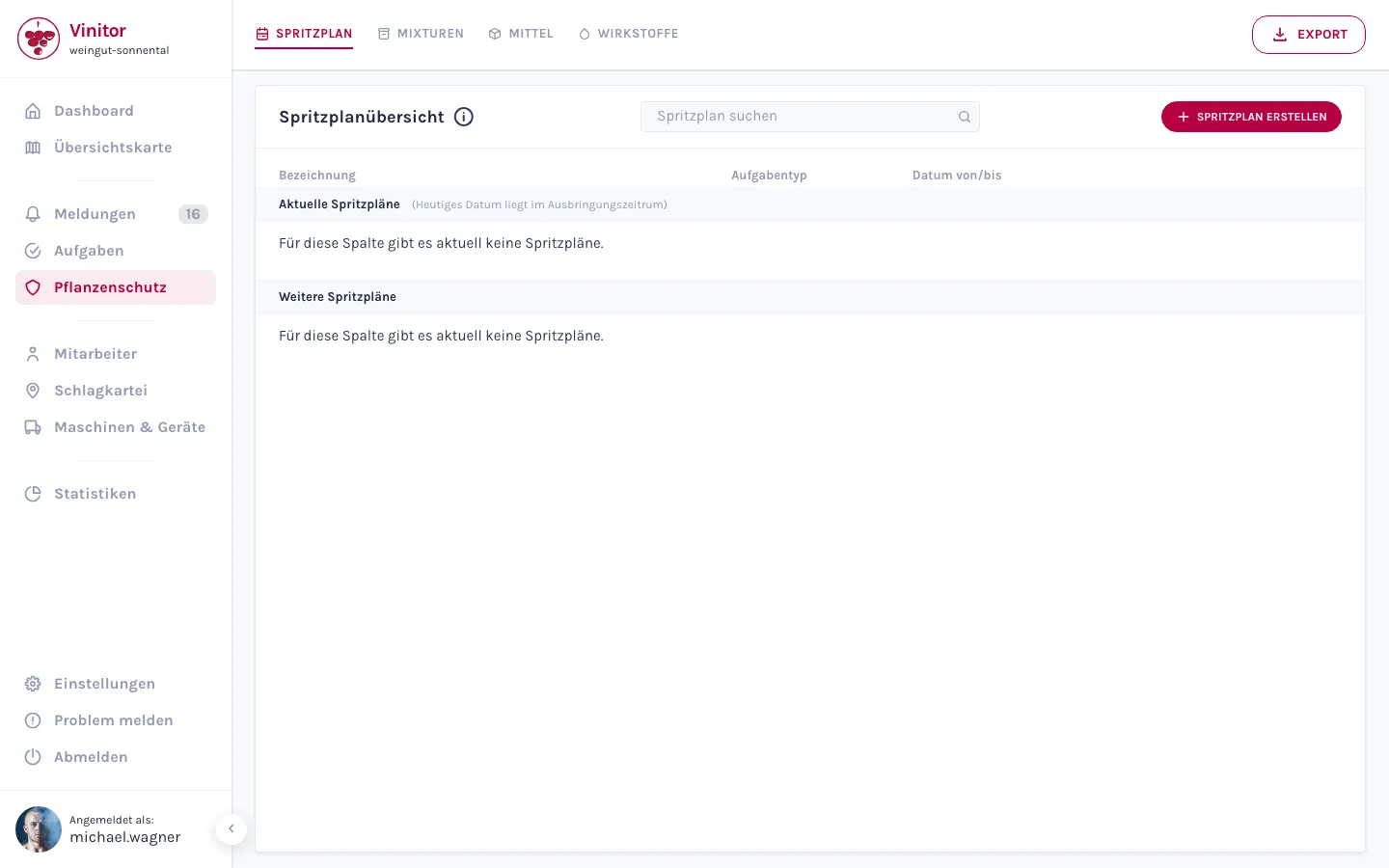
User management & field record book are free forever — you add the plant protection module by vine area. What the module can do in detail — BAES product data, quantity calculation, spray plans — is shown on the plant protection feature page.
Frequently asked questions about the e-records requirement
Is an Excel spreadsheet enough?
Is a PDF file enough?
Does this apply to small businesses too?
Do I have to digitise old records?
Will the deadline be postponed again?
Sources
- Implementing Regulation (EU) 2023/564 — electronic records on plant protection products (EUR-Lex)
- Regulation (EU) 2025/2203 — postponement of the date of application to 1 January 2027 (EUR-Lex)
- Regulation (EC) No 1107/2009, Art. 67 — record-keeping obligation for professional users (EUR-Lex)
- Austrian Chamber of Agriculture — advice and current implementation guidance for each province
This page is a practical summary and not legal advice. As at: July 2026 — it will be updated if the Austrian implementation changes.